Uncle Abe
Anne of AvonleaUncle Abe, Avonlea’s familiar weather prophet, becomes the center of a joke that briefly makes his reputation look less like village folklore than genuine foresight. His distinction is also the source of the episode’s irony: he really had predicted a storm for sometime that spring, but he had not named May 23 or a particular hour. When a severe storm does arrive on that date, the community remembers the newspaper’s precise forecast more readily than his denial of it.
Identity and Reputation
Uncle Abe is known in Avonlea as a weather prophet, a reputation that makes his predictions part of local conversation. His forecasting is familiar enough to be invoked in ordinary plans: while Anne Shirley is preparing for a Thursday dinner, she reports that Uncle Abe had said the previous evening, during a call at J. A. Harrison’s, that rain would prevail for most of the week. Marilla Cuthbert treats the prediction as a promising sign for the weather on the dinner day. The brief exchange establishes how naturally his forecasts circulate through village life, even when their practical value remains uncertain.
The later controversy does not begin with a forecast he actually made in public. In May, notes signed by Observer appear in the Charlottetown Daily Enterprise, and Avonlea gossip attributes them to Charlie Sloane. One note seems to mock Gilbert Blythe, encouraging the village’s existing belief that Gilbert and Charlie are rivals for the affection of a young woman. The apparent local scandal thus gives the newspaper items a social context beyond the weather: their authorship and insinuations become subjects of speculation before the storm prediction is tested.
The Forecast and Its Distortion
Gilbert Blythe and Anne Shirley, not Charlie Sloane, have written the notes. Gilbert includes the apparent sneer about himself as a blind. Only two notes matter to the ensuing events: one predicts a village wedding, while the other attributes a much more specific forecast to Uncle Abe. It says a violent thunderstorm will begin at seven o’clock sharp on May 23 and affect most of the province, advising evening travelers to take umbrellas and mackintoshes.
The difference between the printed claim and Uncle Abe’s actual prediction is decisive. He had predicted a storm at some point in the spring, but he had not assigned it a date. Gilbert himself recognizes the distinction when he remarks that Uncle Abe has indeed predicted a storm for sometime that spring. The newspaper has converted a broad forecast into an exact public pronouncement, giving the prank its apparent authority while setting Uncle Abe up to be judged by words that are not his.
Uncle Abe suspects that Observer is making fun of him. He angrily denies having named a particular date, but nobody believes him. The scene turns on an awkward reversal: the false precision makes the forecast seem more impressive once events begin to fulfill it, while his truthful correction sounds like backtracking. The village’s readiness to accept the printed account over his denial exposes how quickly gossip can become the version of events people remember.
May 23 and the Storm
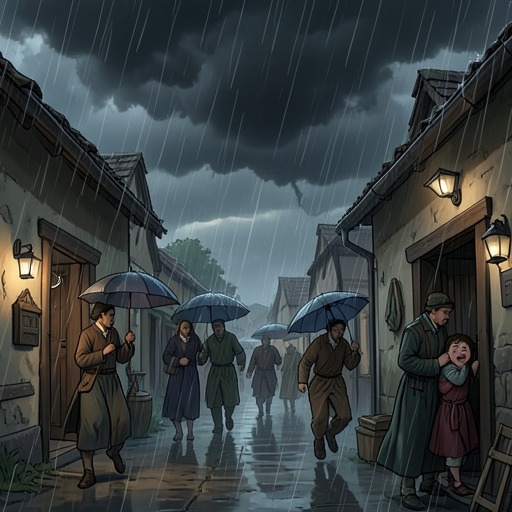
May 23 arrives unusually warm. Anne is teaching fractions and syntax at the Avonlea school, where the pupils swelter through the morning. A hot breeze gives way after noon to heavy stillness; at half past three Anne hears a low rumble of thunder and dismisses the children so they can get home before the storm. This chronology matters to Uncle Abe’s reputation: the newspaper had forecast a seven o’clock beginning, but the first thunder is heard hours earlier. The storm is real, and the date is right, but the advertised timing is not.
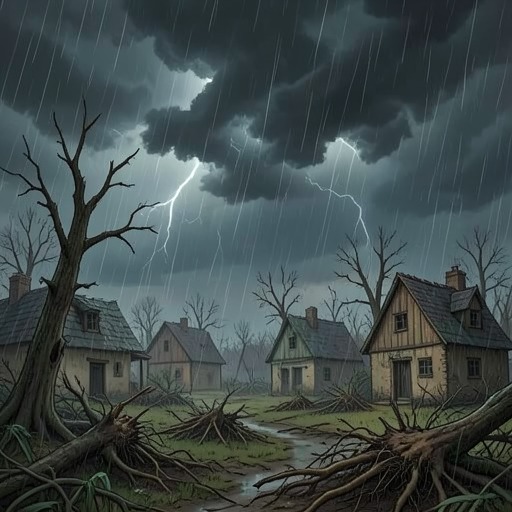
The aftermath is severe across Avonlea and beyond. Hailstones make roads impassable for wheeled travel, and villagers visit one another to compare damage. Late-arriving mail reports houses struck, people killed or injured, communications disrupted, and young livestock lost in exposed fields. These losses are not proof that Uncle Abe’s forecast was precise; they establish the scale of the event that gives his reputation renewed force. The actual storm exceeds the role of a village joke and becomes a provincial disaster.
Vindication and Irony
The following morning, Uncle Abe wades to the blacksmith’s forge and remains there throughout the day. It is, in the narrator’s account, his hour of triumph: he enjoys having predicted the storm, and especially having got the day right. His vindication is qualified in two ways. The storm was not his joy, and he had not made the exact dated prediction credited to him. Yet once it has happened, he forgets that he ever denied setting the day; the discrepancy in the hour no longer seems important to him.
That small adjustment makes Uncle Abe more than the butt of the prank. His triumph is understandable after the community has dismissed his correction, but it also repeats the distortion that wronged him: he takes credit for a precision he did not claim beforehand. The storm therefore leaves his reputation strengthened and the truth about the newspaper forecast blurred. Through this contrast between genuine foresight, fabricated detail, public disbelief, and retrospective self-vindication, Uncle Abe’s episode shows how a community’s stories can become more durable than the facts that first produced them.